Heather Mason, Founder and CEO of The Minded Institute, sat down with Liz Oppedijk, co-founder of the social enterprise Accessible Chair Yoga CIC and a leading expert on chair yoga, to showcase the accessibility of Chair Yoga.
Liz came to yoga in her 50s following serious illness and injury. Through yoga, her recovery became a transformation, but she was left with a question: how to bring the restorative practice of yoga to people for whom the mat is a barrier? Keep reading to see the full interview:
Heather: So Liz, what first attracted you to Chair Yoga? Why did you start Chair Yoga?
Liz: The first people who I taught mat yoga to were a group of young women at a nursery at the bottom of my road. These young women were so stiff they had trouble getting up off the floor, taking care of little children, and yoga helped them in the same way it helped me with flexibility and relaxation. At the time I was doing lots of volunteer work and we did an action in a local care home. There I had the thought, “The carers – the staff – could really use yoga, just like the nursery staff, and the residents too.”
I asked the care home if I could come along and teach yoga and they said sure! Clearly, though, a traditional mat yoga wasn’t going to be appropriate for everyone. I mean in a care home there are people who can’t stand up and walk, but what I found was that when you do Chair Yoga, everybody is on an equal playing field. So those people who can’t stand up from a chair, those who can’t get up and down off the floor, are able to participate and not feel like they’re not as good.
Yoga is often taught to achieve a certain shape in a pose, although this is changing, where the goal is an advanced expression of that pose. When you do Chair Yoga, particularly when you do it using the Lakshmi Voelker method, the idea is that you start with the person where they are and you grow the movements from there, encouraging each person to find the expression of the pose that works for them. In other words you work from the inside out and there is no idea of a “perfect shape”.
This type of Chair Yoga aligns with a yoga therapeutic ideology, and that’s one thing I love about it.
In this first care home – where by the way they started lovingly calling it “armchair yoga” – I ran chair yoga sessions as a trial. We did yoga twice a week for two months, and we asked the residents and staff to fill out questionnaires before and at the end of the entire intervention. They all were so enthusiastic about it, and one of the big things that the management said to me was: “After you do this, everyone is so calm – the whole care home is so calm.”
In most care homes, many of the residents have never done yoga before. In this first care home, I had one student who had practised yoga before and could do very advanced movements even though she had Parkinson’s and dementia. All these people were in the same room with varying levels of mobility, including almost no mobility. Through the chair yoga, however, everyone could participate at their own level. They all felt the meditations were amazing, and one lady, who could no longer speak, still conveyed her joy – you could see bliss on her face at the end of the practice!
I wanted to bring yoga to people who especially think, “Yoga – I would never think of doing it.” Chair Yoga allows us to do just that.
Heather: I know that the structure has changed for the Accessible Yoga movement, but you were the European coordinator for Accessible Yoga, so it sounds like the way that you are offering Chair Yoga is uniquely accessible. I wondered if you could add anything to clarify those distinctions?
Liz: When you do training in the Lakshmi Voelker Chair Yoga method, you learn to adapt yoga based on understanding the internal embodiment of how the poses feel to you, and how the movements feel. The techniques work more from an internal basis. The second part of this new course that I’ve developed – Further Chair Yoga Skills – will especially appeal to yoga therapists because that’s where you learn the inquiry skills and the assessment skills that take you to that depth. By assessment, I mean physical assessment, and this is because yoga therapists should already have some physical assessment skills.
Heather: So with the Lakshmi Voelker method, you’re really feeling it in your own body, and that embodiment, we call that interoception, allows you to have a better sense of your body, which in turn means you are able to sense what it might need.
Before I met you, I thought, okay, Chair Yoga is just taking poses and putting them on the chair, and I remember sitting with you one day and you said no, you need to feel almost the same kind of sensations that you would feel on a mat. You need to experience basically the same stretch and feeling of using your strength on the chair.
So, you took me into a Downward Dog on a chair. You didn’t have my hands on the back of the chair and my back and legs straight, which is what I’ve always used in Chair Yoga, and you had me sit there and really press my arms and palms into the air, my heels down and soles pushing forward, and I thought. “Wow, this is so much work and it feels exactly like Downward Dog on the mat – I can’t hold this for a long period of time.”
The only difference, I realised, is that you don’t have full contact with the floor. Being able to experience almost the same asana on the chair really impressed me! I thought, “Whoa, Chair Yoga can be hard!”
I always say this because the impression is that Chair Yoga is just gentle and for people who are older, but you can really sweat on a chair if you want to!
Liz: It’s nice for people with injuries as well. I tore the meniscus in my knee doing the “extreme sport” we call Hot Yoga, coming up from Toe Stand, and I couldn’t do my mat yoga practice, but I could keep doing yoga on the chair. Chair yoga is amazing for people who are undergoing rehabilitation as well as so many of the other things I have mentioned.
Chair Yoga is something that can be done in a corporate environment, or while traveling, where people may feel it’s awkward or inconvenient to do mat yoga but really value stretching their body during the day. It’s useful for those who want to relax their nervous system wherever they are sitting. I think this speaks again to the accessibility piece. Chair Yoga can build strength and be accessible for people who cannot move as much and also if people don’t want to get on a mat for whatever reason, like at work during their lunch break.
Heather: When I read your book, Get Fit Where You Sit, I was so impressed. I review a lot of books on yoga therapy and on yoga, and it was one of my favourite books I’ve ever had to review. You took all the limbs of yoga and you made them accessible while using the chair as a template. We do that in yoga therapy, make everything accessible and person-centred, but your unique slant on it was special.
Liz: Lakshmi Voelker is a great inspiration in this regard. She’s done yoga from the age of 18, starting back in the 1960s, so she’s somebody who grew up with yoga as it grew in the West. It became part of her DNA; it is encoded deep into her cells. She comes from Kripalu, a very well-known approach to yoga in America, based at a beautiful site in the mountains of western Massachusetts.
Kripalu is a Sanskrit word that means compassionate, and this became one of the core principles of her method. Compassion has been completely ingrained in the entire method.
I trust that I’ve been able to put into words a few more of the key principles of the Lakshmi Voelker method in the book and the training. Lakshmi has lived these principles for decades as part of her life, and so when she created the Chair Yoga programme, these principles were inherent. I suggested to her that we mention not only the eight limbs, but also explain all of the principles in a more articulated way as she has a special take on them.
In particular, she talks about the Yamas and Niyamas being the front two legs of her chair. They’re like her support; it’s a perfect metaphor and clarifies how we can feel the true essence of yoga on the chair.
When you do Chair Yoga, you aren’t losing anything or doing a lesser yoga just because you’re doing it on a chair. You are actually making it accessible and really considering the nature of the individual; Lakshmi likes to say that each person creates their own Chair Yoga experience when they get on a chair and practise levels of flexibility. It’s not necessarily that you’re doing more, but you’re adding another layer.
Heather: It’s so beautiful for you to honour Lakshmi, but I also want you to be given credit because I’ve seen your writing and I saw you really come through in the book as well. There is a special way that you understand the eight limbs of yoga that comes across that was inspired by her.
Liz: I just want to read one short passage, because to me this partly embodies what Chair Yoga is all about:
“Practice compassion on the chair: Levels of flexibility allow us to choose what works for us on any given day. It’s not about pushing ourselves into what we believe we can do (or should be able to do) if our body is telling us otherwise; it’s about recognizing and accepting that each day, each week, each month, each year may be different, giving each of us permission to do yoga our own personal way.”
The other reason I feel so passionate about it is that, as a Minded Yoga Therapy graduate, I look at the evidence base, and the recent statistics from the World Health Organization on aging populations support the importance of incorporating Chair Yoga and accessible yoga into our work:
“By 2030, 1 in 6 people in the world will be aged 60 years or over. At this time, the share of the population aged 60 years and over will increase from 1 billion in 2020 to 1.4 billion. By 2050, the world’s population of people aged 60 years and older will double (2.1 billion).”
So, the number of older people is going to double. And people want to keep doing yoga! Yoga can be very beneficial, and the chair is usually going to be accessible for most people. Chair Yoga will help keep people strong and well and able.
The other thing is that you can mix Chair Yoga with mat yoga so that people have a broader range of choice, depending on ability. Maybe a person can’t do one particular pose on the mat, and they want to do it on the chair, or with some movements they find that their body stretches more on or with a chair.
In the second part of the course that I’ve developed for the Minded Institute, we talk a lot more about that and how you can mix and match between the mat, the floor, the wall, and any position you want to!
I’m going to show you Tree pose now:

First, we come onto our chair and set our foundation. The foundational pose is Sitting Mountain. I tend to take off my shoes on the chair, but I always give people a choice. We come into postural alignment, having our knees aligned with our hips, and we raise our torso so that we can bring some space to be able to breathe, as well as space in the back so that we can lengthen our spine. That helps cultivate and maintain a healthy spine and healthy breathing.
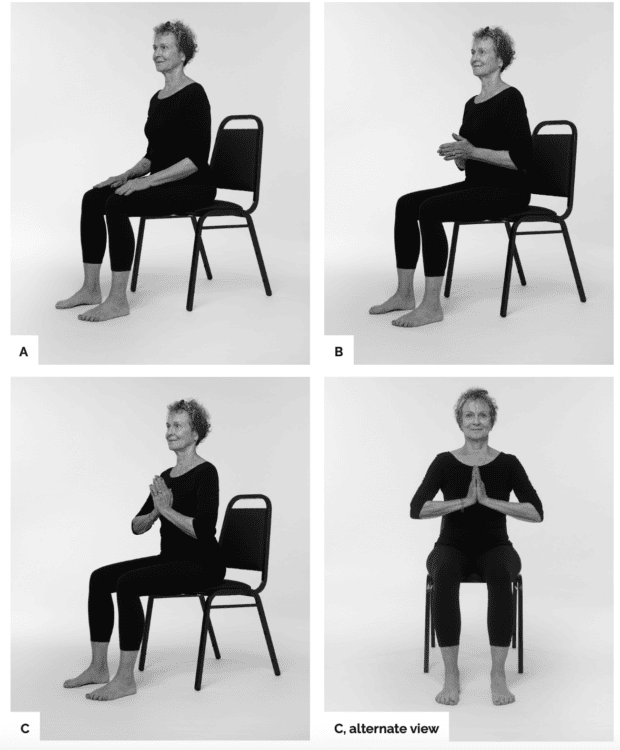
We lift the shoulders up, back, and down, and then we usually pause before we start and take a few breaths.
For Tree pose, we normally start with the lower body first because this again is our foundation, and then begin to open one hip up.
You’ll see here and maybe feel here that some of the aspects of Tree pose you can get by just opening up one hip on the chair, and leaving the other leg in its firm foundation in Sitting Mountain pose.
You can stay there if you wish, or if you want to, you can cross one ankle over the other ankle. The next option could be where you bring your leg up and place the ankle just above the knee; not on the knee but on the thigh, bringing the toes up, so flexing the foot towards the knee.

One of our sayings is:
“If you feel a pinch, go back an inch.”
We encourage people to do what works for their body, not to push.
Then I always say, “Everybody choose your option”, so everyone chooses what works for their body, and they all do that, so all different abilities are able to take part in the same class.
With the upper body, we may start having our hands together in front of the heart, or raise them up overhead. Depending upon your shoulders, you may raise your arms up over your head, and sit up tall.
We then take three breaths, breathing in through the nose if that’s available to you, or if not, breathing through the mouth is absolutely fine.
We do the same on both sides of the body to be balanced. What’s interesting about this is you can really focus on the lifting of the arms and the stretching of the spine, the opening of the hip, and how they come together to form a full yoga pose.
I’d also like to add that you could technically come off the chair and use the chair as a prop and a support; there are just so many things you can do whether you are working more on just the balancing aspect of the pose with support or want to achieve other benefits.
Chair Yoga is really about understanding what is the benefit that you’re trying to derive from this pose. You can derive all the benefits of the mat pose in one or more chair yoga poses. For those with limited movement, there is the opportunity to focus the attention on different aspects of the body and learn to move in a useful way.
Heather: Is there anything you want to say before we end?
Liz: I really just want to invite more people to come and train because we need more Chair Yoga teachers! I’m looking forward to more people coming along, and I trust that the book will of course bring Chair Yoga to more people as well.
Namaste
Watch the full interview here over on The Minded Institutes’ YouTube channel.
If you are not a yoga teacher but you are a a healthcare professional or carer and you’re interested in Chair Yoga, you can take Liz’s one-day course: Online CPD: Basic Yoga Techniques for Health Professionals.
By following this course, you can enter Part 1 of her Chair Yoga Teacher Training:Accessible Chair Yoga for Yoga Therapists to add to your toolkit. Whether it is to work with clients, with other people in your life or simply for yourself!
About Liz:
Since training in the Lakshmi Voelker Chair Yoga method, Liz has taught Chair Yoga to people with a huge range of abilities, including those who are totally new to yoga, those with Parkinson’s, MS, stroke, cancer and other conditions as well as those with dementia, learning disabilities and also their carers. So looking at a systemic and holistic approach. Her dream is to train a community of chair yoga teachers to bring yoga to care homes across the United Kingdom.
Liz has recently carried out research studies on yoga in care homes and mindfulness for Parkinson’s, and she lectures at The Minded Institute. It seems like the areas she lectures on keep growing because she’s so fantastic at making topics accessible.
She is also a regular facilitator on Jivana Heyman’s Accessible Yoga course, and she has her 200-hour yoga teacher training as well as her 300-hour advanced yoga teacher training, which she did in 2019; she qualified with The Minded Institute as a Yoga Therapist in 2021, has a postgraduate certificate in yoga and oncology, and she continues to do her work in care homes and online. She provides support for carers as well, and she was the person I thought of first when I said we really need Chair Yoga training for yoga therapists because that makes yoga therapy more accessible. We have developed a course for The Minded Institute, and so I really wanted an opportunity to share some of her insights with those who might want to do her course, or who just want to know more about Chair Yoga for themselves and also professionally.