
by Heather Mason and Libby Walunas
The classic yoga therapy framework of the five koshas provides a vista for whole-person accessibility in yoga and inclusivity for numerous populations. Yoga therapists can collaborate with each marginalised individual to create a strengths-based, person-centred plan through the panchakosha model, rather than “modifying” an ableist or exclusionary “ideal” method.
Yoga therapists must consider where marginalisation may appear not only in social contexts but also within a client’s body, vitality, mind, and sense of self. Examples of groups who are marginalised across domains include disabled people, racialised groups, gender/sexual minorities, people with mental health issues, neurodivergent people, and any combination of intersectional identities, including education and socio-economic status. Given an unwelcoming space or uneducated provider, the full benefits of yoga therapy are just as inaccessible as in a building with no wheelchair ramp.
Accessibility work can happen across a number of domains by accepting the individual’s full experience while also focusing on specific areas, for example, bodily needs of physically disabled people or emotional concerns of those with mental health complaints. It is vital for the yoga therapist to consider all aspects of the person in terms of accessibility and adaptability needs. This holistic approach appears in the panchakosha theory of interconnected whole-person existence, which aligns with the human rights model of disability and with other difference-affirming models, such as the neurodiversity paradigm, that acknowledge the reality of impairments while combating ableism and celebrating human variety. Yoga therapists can begin the work by identifying their own positions on the “Wheel of Privilege and Power” across multiple koshas.
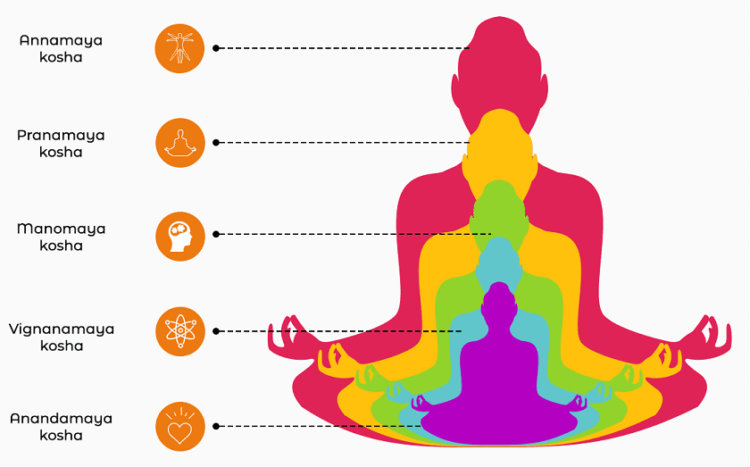
Below are some accessibility reflections relevant to each of the koshas. Because trauma is prevalent in so many populations, it is important in all encounters to employ trauma-informed practice and communication choices when working with each kosha.
Annamaya kosha (physical layer)
- Adaptive yoga may make asana and exercise safer and more accessible for disabled, elderly, or larger-bodied people either on a mat or with chair yoga.
- Lifestyle recommendations may be affected by food insecurity or lack of hygiene resources.
Pranamaya kosha (energy and breath layer)
- Expectations must reflect sensitivity to fluctuating abilities and energy levels due to disabilities, mental or social status, or chronic illness.
- Economic status and job timing may affect recommendations for rest or sleep timing, sleep environment, and other elements of self-care or lifestyle.
- Adaptations may be required for larger-bodied clients whose breathing is affected by body composition.
- Vocalisation practices may be helpful across pranamaya and manomaya koshas in developing breath control, self-regulation, and self-expression, especially for people who are used to having their voices overruled and their lived experiences invalidated by professionals.
Manomaya kosha (sensory, emotional, and interpersonal layer)
- Sensory environmental adaptation and customised communication strategies can help support clients with autism or other neurodivergences.
- Gender-neutral or gender diversity-affirming actions (such as normalising gender-neutral language and clothing) can build trust with gender non-conforming clients.
- When teaching meditation, the yoga therapist must include strategies for adapting practices to the client’s mental state or neurodivergence.
- Validation of perspective and of strong emotions may be a big part of establishing trust with some clients, including those with rejection-sensitive dysphoria secondary to attention deficit/hyperactivity disorder (ADHD), those with pathological demand avoidance secondary to autism, or those with mental health issues such as mood or personality disorders.
- Some clients may respond well to embodied inquiry if verbal communication is not their best method of learning or expression, for example, autistic clients or those with certain brain injuries or other neurological conditions.
- Clients may come from social or cultural contexts that do not promote talking about feelings or grievances.
- Part of language awareness work is asking individuals how they would like to be identified and then respecting their wishes (for example with gender-affirming pronouns), as well as researching preferred terminology within specific communities before advertising to them.
……
Read the full article on IAYT for Global Yoga Therapy Day.
SUGGESTED RESOURCES
Off the Mat Into the World (multiple pathways to equality and justice through yoga)
Accessible Yoga (accessibility of all kinds)
Dianne Bondy Yoga (accessibility and belonging of all kinds)
The Minded Institute (professional yoga therapy and integrative psychotherapy training in numerous areas including trauma, autism, chair yoga, chronic pain, and more)
Yoga for All Bodies (larger bodies, elders, and more)
Curvesome Yoga (larger bodies)
Trauma Center Trauma Sensitive Yoga (general trauma-informed and specialised trauma-sensitive trainings)
Eat Breathe Thrive (eating disorders)
Sue Hutton (neurodiversity-competent mindfulness)
Love Your Brain (acquired brain injury)
Rhythms Yoga Training (children’s mental health)
Yoga Nidra Network (post-lineage/non-hierarchical yoga nidra; women’s health, pre- and post-natal)
Tristan Katz (LGBTQIA+)
Prison Yoga Project (trauma-informed yoga for incarcerated people)
Jessica Kingsley Publishers (social justice-minded books for relevant professional education)
Singing Dragon and Handspring (books on yoga and related modalities)
The Teacher’s Guide to Accessible Yoga by Jivana Heyman
Get Fit Where You Sit by Lakshmi Voelker and Liz Oppedijk
Teaching Body Positive Yoga by Donna Noble
Yoga for Everyone by Dianne Bondy
Transforming Ethnic and Race-Based Traumatic Stress with Yoga by Gail Parker
Trauma-Aware Yoga and Movement Therapeutics for Older Adults by Beth Spindler
Trauma-Informed and Trauma-Responsive Yoga Teaching by Catherine Cook-Cottone and Joanne Spence
Overcoming Trauma Through Yoga by David Emerson
Yoga for Mental Health edited by Heather Mason and Kelly Birch
Yoga on Prescription by Paul Fox and Heather Mason
Post-Lineage Yoga by Theodora Wildcroft
Yoke: My Yoga of Self-Acceptance by Jessamyn Stanley
The Body Is Not an Apology by Sonya Renee Taylor
Neuroqueer Heresies by Nick Walker
The Neurodiversity Reader edited by Damian Milton
Crip Kinship by Shayda Kafai
Care Work: Dreaming Disability Justice by Leah Lakshmi Piepzna-Samarasinha
Disability Visibility edited by Alice Wong
My Grandmother’s Hands by Resmaa Menakem
The Inner Work of Racial Justice by Rhonda A. Magee
The Racial Healing Handbook by Annelise A. Singh
LIBBY WALUNAS (MA, C-IAYT, RYT 500, OHYA Level 3)
Libby is a certified yoga therapist, yoga instructor (since 2005), breathwork coach, and embodiment coach. Her special interests include yoga therapy for mental health and the integration of traditional Indic texts and knowledge systems into “Western” yoga therapy and yoga instruction. As a late-diagnosed autistic adult, she also feels called to promote the accessibility of yoga to neurodivergent adult populations. She is a guest lecturer on neurodiversity and autism for The Minded Institute and the author of a forthcoming Singing Dragon book on yoga therapy for autistic adults. Instagram: @clarion_yoga
Heather Mason is the founder of both The Minded Institute, an internationally renowned yoga therapy school, and the Yoga in Health Care Alliance, focused on bringing yoga into the UK’s NHS. She holds master’s degrees in Buddhist Studies, in Psychotherapy, Medical Physiology, and has extensive training in Neuroscience. Heather has been teaching yoga since 2001 and has specialised in the use of yoga therapy for mental health populations since 2007. She designed and taught an elective on yoga at the Boston University School of Medicine and created and taught the bioscience course the MUIH launched its MA in yoga therapy. Actively focused on the integration of yoga into healthcare, in 2018 Heather helped create an All-Party Parliamentary Group, “Yoga in Society”. Heather has also co-authored “Yoga for Mental Health” and “Yoga on Prescription”. In 2023 Heather and co-director Elaine Collins developed the first yoga psychotherapy course in the world. This course is accredited by the NCIP. Learn with Heather by visiting The Minded Institute and follow the latest news in yoga, science and mental health on social media at @themindedinstitute.