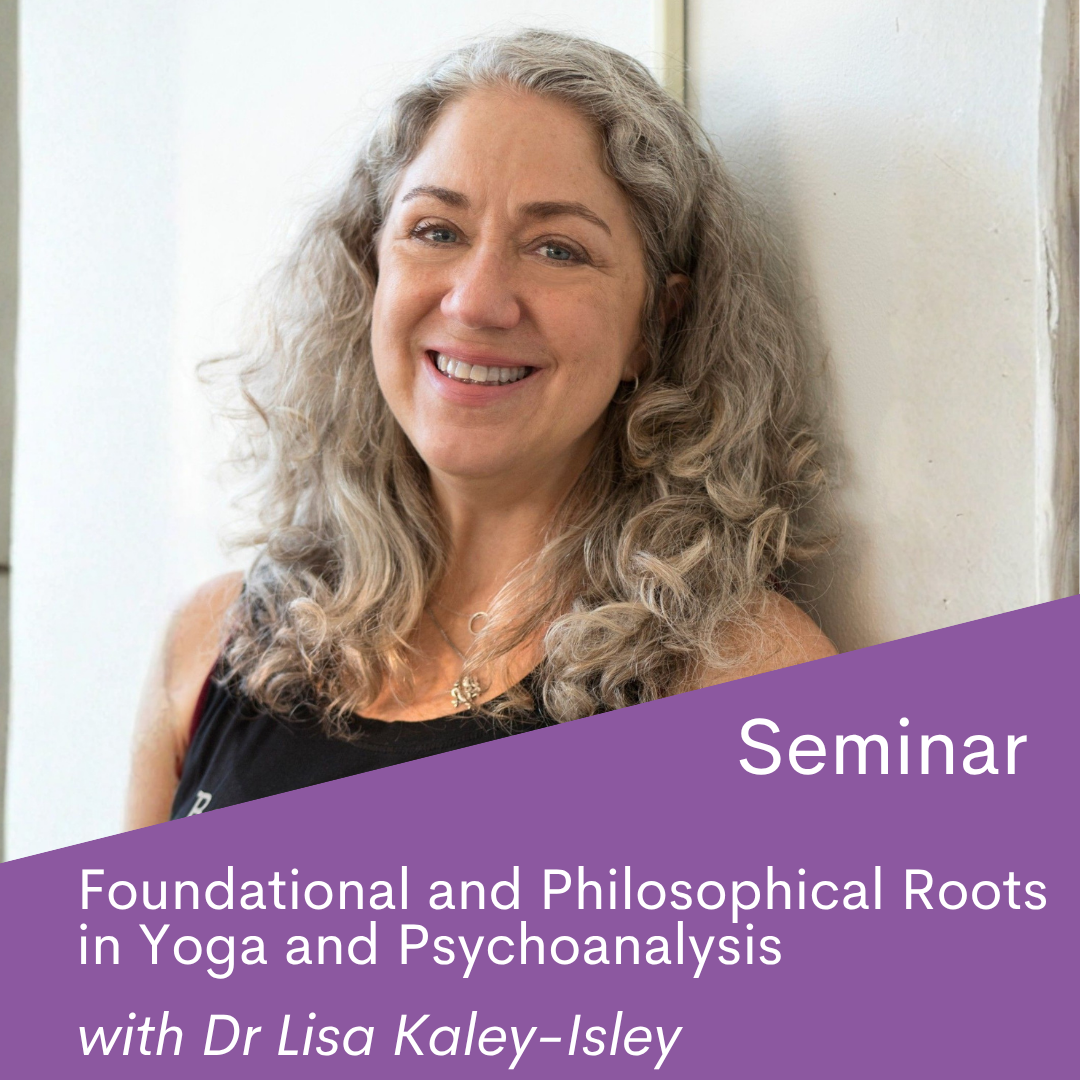
On Demand Seminar: Foundational and Philosophical Roots in Yoga and Psychoanalysis
£40.00
Yoga and psychoanalysis both ask how the mind works, why we suffer, and what makes lasting change possible. In this two-part on-demand seminar, clinical psychologist, yoga therapist and researcher Dr Lisa Kaley-Isley explores these questions through both traditions.
The first session introduces foundational concepts from yoga philosophy; the second explores Freud’s psychoanalytic theory in continual comparison with them. Together, the sessions reveal where these traditions describe similar ground in different language, where they genuinely diverge, and how yoga philosophy might inform and potentially improve mental health treatment. Both sessions are included and are not available to purchase separately.
Watch both recorded sessions at your own pace on our student learning platform. Click the purchase button to register and access the seminar.
Description
Yoga and psychoanalysis are two methods, one ancient, one modern, for understanding how a human being develops, stays the same and changes. Both have changed enormously in how they are practised. But specialists in each field continue to draw on the same core principles first laid out in their foundational texts, because those principles still hold.
Reaching them, though, usually requires a guide: the language, the sources and the historical context are not something most people are ever handed access to. In these sessions, Lisa offers that access, showing what these traditions still have to teach us and how they continue to underpin the methods used today in yoga therapy and psychotherapy.
Yoga and psychotherapy both have theory and practice. Practice puts into action what theory seeks to explain, and understanding both, along with the relationship between them, deepens our ability to apply either with purpose. In the West, we often emphasise practice over theory. These sessions do the opposite: they emphasise theory in order to strengthen practice.
Yoga and psychoanalysis share many of the same underlying observations about the human condition, described in different words. Both emerged from sustained internal reflection and external observation over time, and both were motivated by a desire to understand human experience and to live more meaningful, harmonious lives.
In much the same way that modern science sometimes rediscovers, through its own methods, realities earlier yogis had already described, these sessions ask what remains true and useful in how yoga and psychoanalysis have each understood and worked with the human condition.
Yoga and Psychoanalysis Session One: Yoga Philosophy and Psychology
The first session builds the yogic foundation. Drawing on the Vedas, Upaniṣads, Yoga Sūtras and Bhagavad Gītā, Lisa introduces core concepts, including karma, saṃskāra, vāsanā, dharma, and Puruṣa and Prakṛti, as ways of thinking about perception, conditioning, suffering, agency and change. Both sessions are included and are not available to purchase separately.
What You’ll Learn
- Key concepts for understanding our relationship to the world, suffering and its relief, including Brahma, dharma, karma, saṃskāra, vāsanā, Puruṣa and Prakṛti—the evolutes, guṇas, elements and senses—as well as truth, reversal, pleasure and pain
- How this understanding builds agency and reduces obstacles, both for ourselves and in therapeutic work with clients
- Core principles describing how the mind develops, sustains stability and changes
- Life stages and the existential questions that come with them, preparing us to hold space for these questions with clients and in our own lives
- Textual sources including the Rig Veda, Upaniṣads, Yoga Sūtras and Bhagavad Gītā
Session Two: Freud’s Psychoanalytic Theory
The second session turns to Freud’s foundational psychoanalytic theory: drives, defences, repetition compulsion, the pleasure and reality principles, transference, and the topographical and structural models of mind.
Rather than teaching this as a separate system, Lisa continually refers back to the yogic concepts from session one. The second session therefore builds a comparison as it progresses, showing where these two traditions describe similar ground in different language and where they genuinely diverge.
What You’ll Learn
- Key concepts including drives, defences, the topographical and structural models of the mind, transference, repetition compulsion, the reality and pleasure principles, and body-based stages of development
- Core principles including making the unconscious conscious, self-revelation and working with defences
- Intrapsychic and interpersonal development across the life stages
- The writings of Sigmund Freud as the session’s principal textual source
- How these concepts can be read alongside the yogic framework established in session one

What You’ll Gain
- A starting point if these ideas are new to you, or a deeper and more applied understanding if you already have some grounding in them
- A clearer sense of the concepts underlying both yoga practice and the psychotherapies that came after it
Specialist knowledge like this is only useful if it is reachable. Left in its original language and context, without a guide, it stays out of reach for most people, however sound it remains.
In these sessions, Lisa does as yogis have done across the millennia: she keeps this knowledge alive by showing its relevance to our own lives, so it can be passed on for the benefit of others.
Who Is This Yoga and Psychoanalysis Seminar For?
Anyone curious about these questions is welcome.
These lectures were originally developed for students on The Minded Institute’s Integrative Yoga Psychotherapy Diploma. This seminar opens up material that is normally restricted to that programme.
About Dr Lisa Kaley-Isley
Dr Lisa Kaley-Isley is a clinical psychologist, senior yoga teacher, certified yoga therapist, yoga therapy educator, and creative writing for therapeutic purposes facilitator. Lisa draws on all aspects of her study and experience to integrate yoga philosophy, psychology and practice in her teaching and provision of yoga therapy.
Teacher
Dr Lisa Kaley-Isley is a clinical psychologist, senior yoga teacher, certified yoga therapist, yoga therapy educator, and creative writing for therapeutic purposes facilitator. Lisa draws on all aspects of her study and experience to integrate yoga philosophy, psychology and practice in her teaching and provision of yoga therapy.
Lisa has a long history of uniting scholarly activities of study, teaching and research with professional development in psychology and yoga. In the US, Lisa was Chief of Psychology at Colorado Children’s Hospital, where she trained psychologists, provided yoga therapy and conducted yoga research, while also serving as President of the Colorado Psychological Association.
In the UK, Lisa was co-director of the Yogacampus Yoga Therapy Diploma course and Clinical Director of the Yoga Therapy Clinic. Lisa has published peer-reviewed journal articles and book chapters on yoga therapy. She has presented on yoga therapy and mental health at conferences in the US, UK, India, Japan, Brazil, Bulgaria, the Netherlands and Singapore. Lisa is a past member of the IAYT Accreditation Committee and a founding member of the Global Consortium on Yoga Therapy.
Lisa is a long-term student of the Himalayan Institute and has been initiated into the Sri Vidya tradition by Pandit Rajmani Tigunait, Rolf Sovik and Rod Stryker. She continues to study with her yoga therapy teacher Gary Kraftsow in the Viniyoga tradition.
Now resident in the Netherlands, Lisa continues to teach yoga and yoga therapy and to provide yoga therapy in person and online. She also enjoys writing, cycling, walking in the North Sea and taking care of her elderly cats.
Learn more about Lisa’s work integrating yoga and psychology on her Life Tree Yoga website
Payment Options
You can pay securely at checkout using a credit or debit card or PayPal.
If you experience any issues during purchase, please contact accounts@themindedinstitute.com and our team will be happy to assist.
You can review the Professional Training Terms and Conditions for courses with The Minded Institute here.
On-Demand Learning Platform
The Minded Institute website is used for browsing and purchasing courses. Upon purchase, you will be redirected to our dedicated student learning platform, where you can access your courses, recordings, and learning library, and track your course progress.
By completing your purchase, you confirm that you have read and agree to our Terms & Conditions and Privacy Policy.
Related products
-
On Demand Seminar: Bringing Yoga Therapy into Healthcare – Past, Present and Future
£20.00 Purchase Seminar -

Online CPD: Yoga Therapy Skills for Depression and Anxiety
View productsDate: Dates tbc – click here to join the Priority List for first access and a limited-time booking offer.
Time: 9am - 6pm (each day, UK time)
-
Online CPD: Yoga Therapy for Perinatal Mental and Physical Health
£800.00 Book this TrainingDate: Module 1: Thursday, 12th - Sunday, 15th November 2026
Module 2: Thursday, 25th - Sunday, 28th February 2027Time: 10am to 6pm (each day, UK time)
-

On Demand Seminar: Living in Integrity as Healing Professionals – A Two-Part Series with Michael Lee
£35.00 Purchase Seminar